
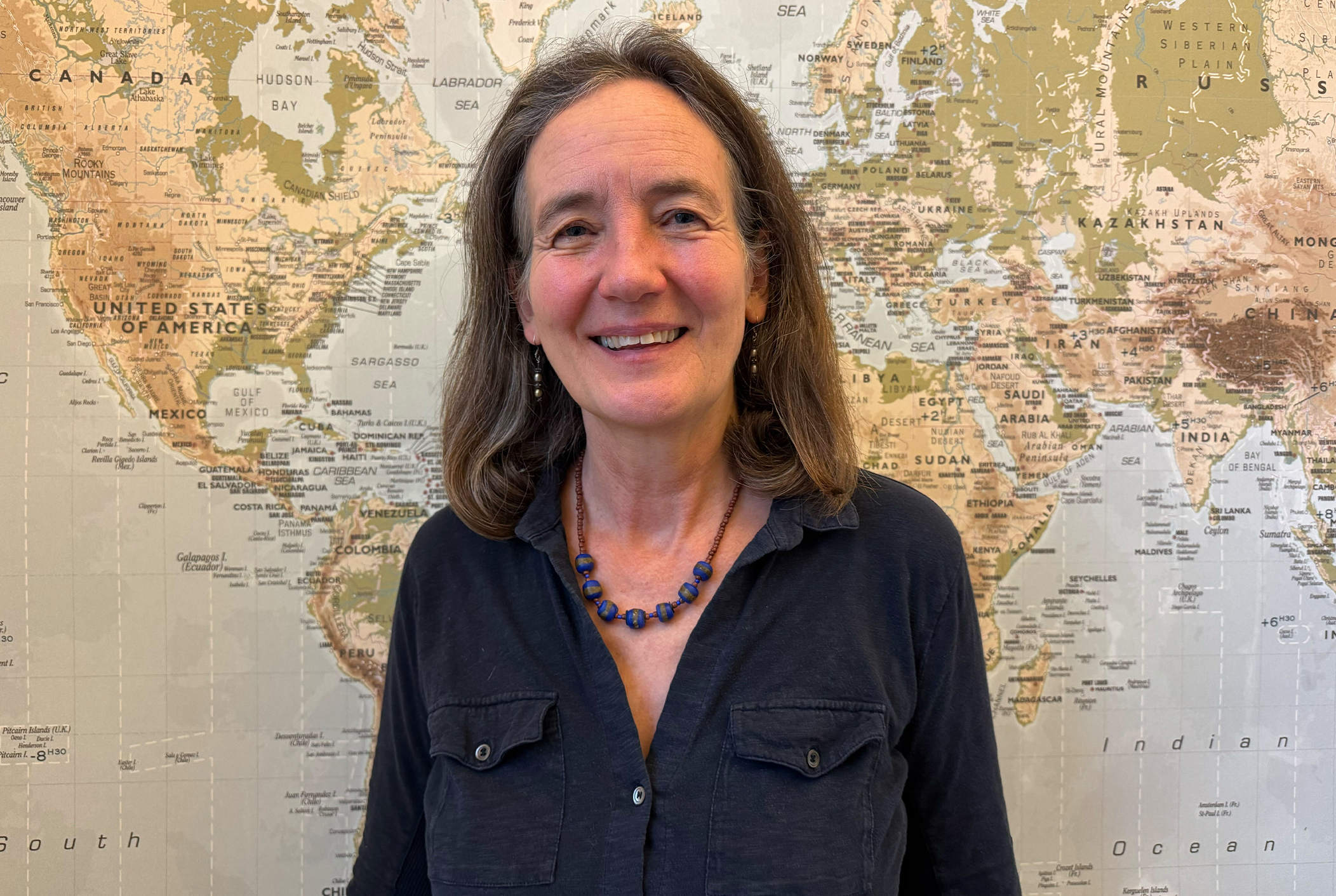
Even from an early age, Katherine Gough was always interested in geography and the world around her. She especially enjoyed collecting postcards and reading books about people and cultures from different countries. Through her parents’ experiences working in various regions, Katherine always understood that the world was much larger than her own community.
– Somehow from a young age, I just had this fascination with different parts of the world and the way in which people lived there. That’s fundamentally what I research on, says Katherine Gough.
Katherine completed her undergraduate studies at University of Cambridge, she then went on to pursue her PhD at University College London. While completing her doctorate, Katherine was also expecting her first child and decided to relocate to Umeå to join her boyfriend, whom she later married.
PhD students in the United Kingdom do not receive maternity leave or benefits, and are required to take a leave of absence when needed. Two years after relocating to Umeå, Katherine and her family moved to Copenhagen. While living there, she had her second child and completed her six-year long thesis.
– Then I had two options: Do I write papers or do I learn Danish? And I decided to learn Danish. I spent six months intensively learning Danish and that then enabled me to apply to the Department of Geography to teach one course, says Katherine Gough.
Upon completing the intensive Danish course, Katherine was appointed as an Undervisingsassistant, similar to a teaching assistant position, at the University of Copenhagen. Beginning with only one class per semester, she steadily built her role in the department where she later taught three courses per semester.
– I was running seminars in Danish, where I understood most but not all of what people said. But I was young and determined, Katherine says.
– I was sitting until two in the morning with a dictionary underlining words like udvikling, which means development. But anyways, I survived and they liked me, she continues.
Eventually, the Department of Geography at the University of Copenhagen advertised three postdoctoral positions specifically for women. In order for an applicant to be considered, there were numerous criteria that had to be met. Katherine was the only applicant from the geography department applying for a position. However, when she went to put together her application, an unexpected challenge waited.
– When I was deciding what project to do, I was told forget Latin America, says Katherine Gough.
This came as a surprise, given that her initial PhD research looked at low-income housing in Colombia. In particular, ‘self-help housing’, the process whereby people build their own homes.
Seeing as Latin America was no longer a viable option for research, Katherine had to choose between Africa or Asia. At the time the Dean had very close connections with Ghana – that gave Katherine an idea.
– I was totally strategic. I devised a project that was looking at peri-urban Accra, Ghana and I was very fortunate that I got one of those three posts.
– I remember the moment when the phone rang – it was before mobile phones – when the phone rang in the living room and I was told I’d got the position, because that gave me a chance to get back into academia, says Katherine.
Katherine’s inability to continue her research in Colombia opened the door to new research in Ghana. She now focuses primarily on Ghana, but continues to engage with Colombian research in some projects.
– I’ve also been involved in various comparative projects over the years. I have worked in various parts of Latin America, Africa, and Asia. We had one project on ‘Youth and the City’ and for that there were anthropologists doing in-depth studies in Brazil, Zambia, and Vietnam…and I conducted research on youth and the home across all three countries, says Katherine.
Katherine’s research in Ghana has focussed on youth, including what it is like for young people living with their parents while beginning to establish their own independent lives. She highlights that Africans are highly entrepreneurial, especially the younger generation.
– That’s because there are very few formal sector jobs fundamentally, in a country like Ghana. You’ve got around 80% informally employed, so people have to create their own employment. We were looking at the types of jobs that they created.
After spending 20 years in Denmark, Katherine moved to the United Kingdom in 2010 with the hopes of becoming a professor. Two years later, she was promoted to professor of human geography at Loughborough University.
– One of the great things about moving universities is you’re then exposed to different research, says Katherine Gough.
Developing her career in the United Kingdom allowed her to spend time with her elderly father and work toward her hope of moving back to Scandinavia to be closer to her daughter, friends, and former colleagues. When Katherine saw that an advertisement was posted for a professor of Human Geography at Lund University she knew it was her chance to move Sweden and onto the next stage in her career.
– I was keen to move back to Scandinavia for multiple reasons. I’d lost my father by then, so there wasn’t anything keeping me in the UK. Also, as I’d got to this stage in my career, if I was going to move, it’s got to be now, says Katherine.
Katherine emphasizes that an academic career is rarely linear, even if you think you know exactly where you’re headed.
– I think what I would say to younger people is, you just can’t know what lies ahead in the future. But I believe quite passionately that you can make things happen. Most things work out for the best, certainly if you make them, says Katherine Gough.