


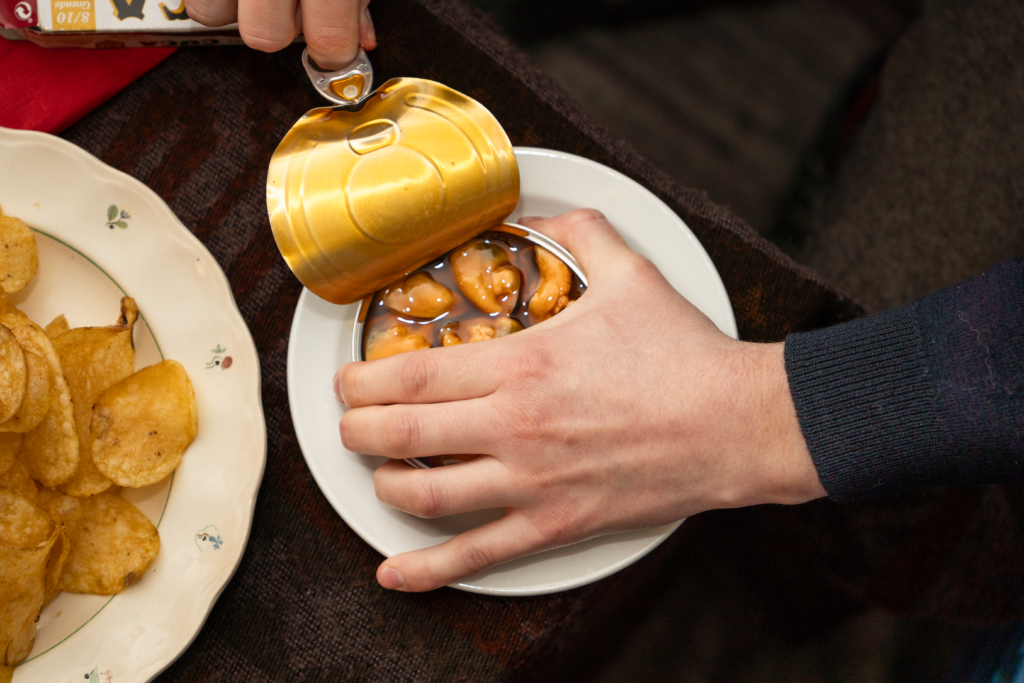
mussels. Photo: Laura Lyall Folkman.
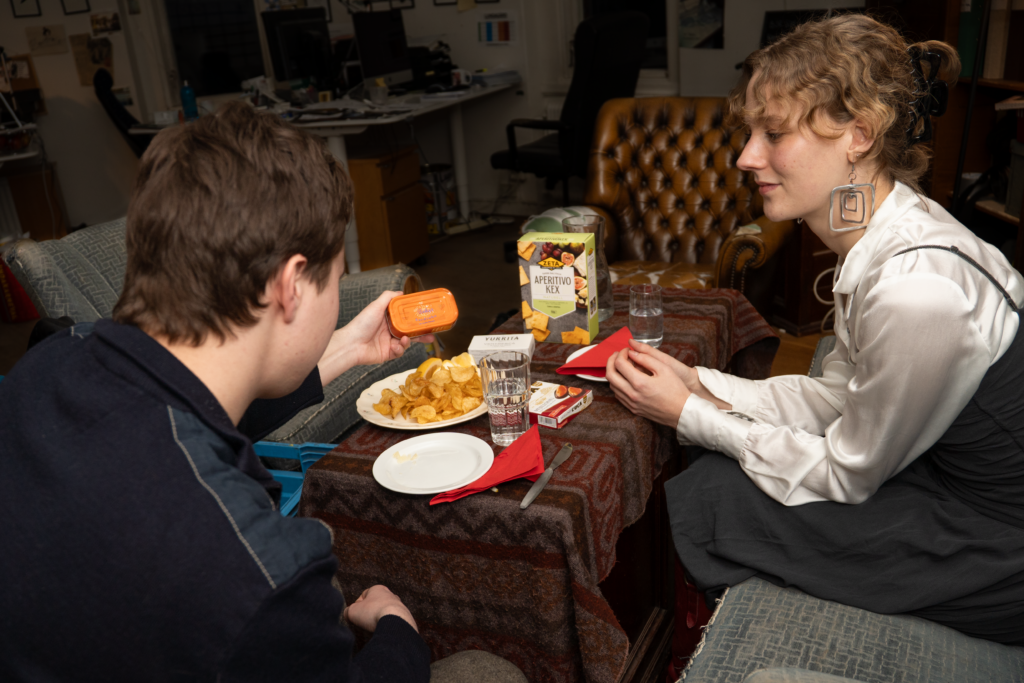
Right after Valentine’s day, one of Lundagård’s writers meets Isaac West, 23, in the Lundagård office for a very special occasion. Isaac is a sociology student at Lund University, but probably most well-known for his Instagram account lyxburken (“the luxury tin can”), where he unboxes and reviews luxury tins of fish and other seafood. As his unconventional meals gain popularity online, Isaac’s account has grown rapidly over the past year. He is at Lundagård’s office in AF-borgen for a ‘post-apocalyptic date’ to share his special interest and to try out some of his favorite luxury tins.
Isaac started his Instagram account last September and his videos were an immediate hit. Swedish media has even picked up on his unconventional passion. After the table is set, Isaac shows us what cans he brought for the date tonight. To highlight the diversity of luxury tins available, and to showcase some of his personal favorites, he brought three different cans. The first is mussels in escabeche (olive oil, white wine vinegar, and herbs), the second Portuguese sardines, and finally fatty tuna belly. A diverse and luxurious meal to enjoy post-apocalypse.
– Tuna, mussels, and sardines. This selection is kind of like my top three, Isaac says.
It may seem unconventional for a Swedish student to develop a passion for rare, foreign tins of fish. Isaac’s interest began when he was studying in Spain.
– Last summer, do anything during the day. It was too hot. So I was on Instagram a lot, and the algorithm started suggesting canned stuff. And I was like damn, these guys are buying cans for 15 euros. What the hell? And then I bought some random cheaper cans at the store, he says.
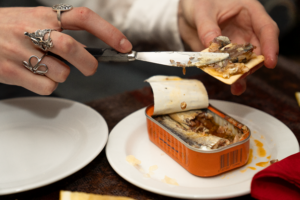
Photo: Laura Lyall Folkman.
A few weeks later, Isaac found a store selling only canned fish in Málaga, where he bought some different, slightly more expensive cans of fish. After he compared them side-by-side with the cheaper ones, he was surprised.
– I didn’t think there was gonna be a difference, but there actually was a difference, and they were so, so good. I was like, I have to buy more of these cans. And I just filled my suitcase, and brought them back with me to Sweden.
But he wanted to do something more with the tins he’d bought and give a platform to what he refers to as a ‘historical craft’. Canned foods, and canned fish in particular, doesn’t have the best reputation in Sweden: often, tins are bought as a cheaper alternative to fresh fish, or because of their high protein content. Isaac wanted to show the variety and craft hidden beneath the shabby façade, and introduce them to a new audience.
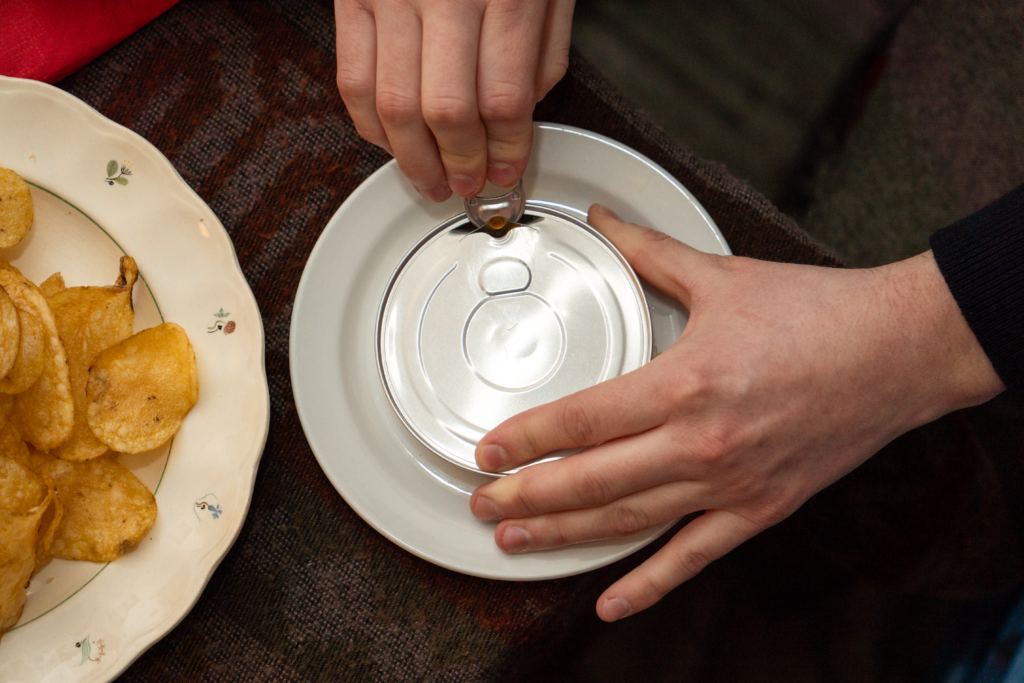

can of tuna.
Photo: Laura Lyall Folkman.
While the feedback to his content on Instagram has been overwhelmingly positive, some commenters point out the high price point of most of the cans Isaac reviews, which makes trying them less accessible for those on a student budget. Although Isaac finds this a valid point, for him, discovering and sharing special tins is a hobby and a passion, not something to be eaten at every meal.
– My focus is on the more high quality ones, and I have to do more Swedish cans as well, Isaac says.
– You can just open up a cheaper can for a quick dinner or whatever. I do that as well. I see it more like a nice cheese, or a nice wine. It’s something that I like to indulge in, a hobby in that sense.
– For most hobbies you have to spend some kind of money., he says.
Although Isaac finds the expense worth it, he says that it does add up.

– I eat an expensive can for my videos at least a couple of times a week, so it definitely adds up, but it’s manageable.
Isaac doesn’t make any money off the videos he posts on his account, but he has been thinking about where he wants to take his passion next.
– It would be fun to do some kind of real-world thing.
While we’re trying out the sardines, best served on a very thin cracker with some lemon juice on top, Isaac shared that he’s been thinking about collaborations with bars and restaurants in the future. Right now, however, he’d like to open his own online shop for canned fish and seafood. Facilitating the purchase of these specialty goods in Sweden would make it way easier for people to try them out, Isaac says. That way, he could give his passion a larger platform and share it with even more people.
Have you ever thought of opening your own cannery?
– Oh, I’ve thought about it. That would be pretty cool. There aren’t that many canneries in Sweden, Isaac says.
While he’s mainly sharing his passion for tinned food for fun right now, his ambitions are far greater.
– My main mission is to be the one who changed canned fish in Sweden forever. I want to kind of put it back on the market. There’s no other person in Sweden who’s doing canned fish like this.
Although we may not currently see canned food as modern or trendy, Isaac explains that they were once the pinnacle of food technology.
– It was like modern food, in a way, because it’s a really modern technology, like sterilization processes and everything. I mean, these cans can last for decades, like during an apocalypse, right?
The tins of fish and seafood Isaac brought would be the perfect dinner during the apocalypse, but trying them out and learning about the craftsmanship that goes into creating these tins shows that it is more than just food. These luxury cans are a fun way to expand your diet, experiment, and discover different flavors. All the tins Isaac brought were good, but the tuna was a personal favorite. The best part? He bought this tin right next to his corridor in Sparta, at ICA Tuna.