
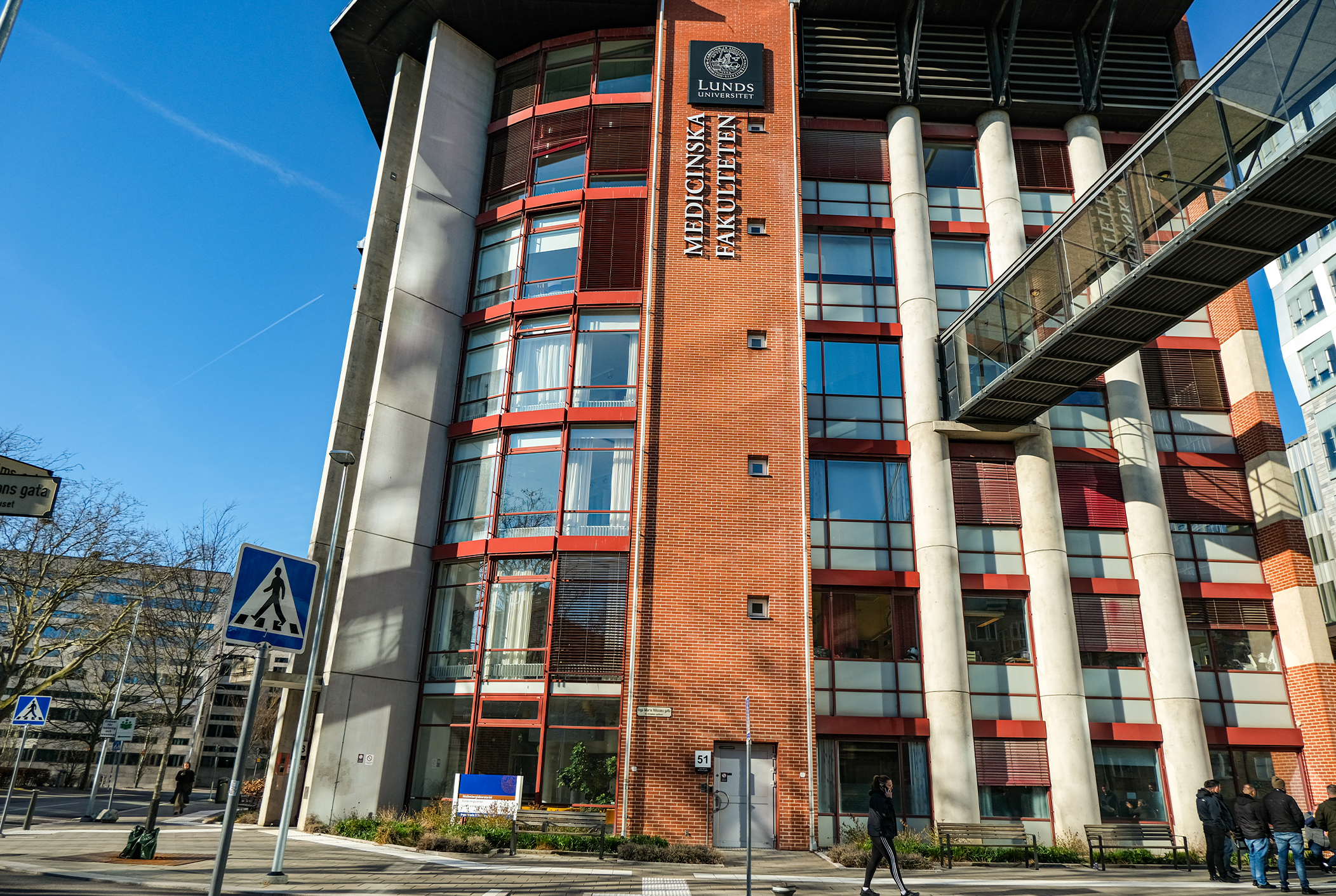
The top floor of the Wallenberg Research Centre is now home to a new hub for virus research. The idea of building a virus centre dates back to 2018, even before COVID-19 hit. Joakim Esbjörnsson-Klemendz, systems virologist and director of LUVC, was one of the main initiators. He studied biomedicine in Lund and returned after a few years abroad to establish his own research group. At the time, virology was a relatively small research field in Lund.
– We had felt for several years that virology needed a stronger and broader focus, Esbjörnsson-Klemendz says.
– We needed to organize ourselves, share infrastructures, and apply for larger grants together.
Discussions with faculty leadership, including then dean and now vice-chancellor Erik Renström, led to a multi-million investment from the Faculty of Medicine. However, when the pandemic broke out, plans were paused as resources were redirected to healthcare.
– It has been a long process, Esbjörnsson-Klemendz says. The centre was officially inaugurated in May 2025, but it is only now that the laboratories are fully operational. Four research groups have already moved in, with plans to expand by recruiting both researchers and bachelor, master and PhD students.
One of the latest recruits is visiting professor Sarah Rowland-Jones from Oxford, a leading HIV researcher who has previously been part of lab startups in Africa and the UK.
– That kind of experience in setting up facilities will be a big help here, says Esbjörnsson-Klemendz.
The laboratories themselves are classified as biosafety level (BSL) 1-3, meaning researchers can perform infection experiments with highly pathogenic or infectious viruses such as HIV, RSV and coronavirus. The facility enables studies that have not previously been possible in Lund.
– One thing that is special here is that we can now work with airborne infections, which was not possible before, says Esbjörnsson-Klemendz.
– This allows us to broaden our research. Our goal is to expand and study a wider range of viruses.
Airborne viruses, such as influenza and coronavirus, pose the greatest risk of spreading globally and triggering a new pandemic. They constantly mutate and have a high potential to jump from animals to humans. During this jump, a so-called genetic bottleneck can occur, where only a few, but potentially very dangerous viruses survive. They can carry mutations that help them evade or trick the human immune system. This is what can cause severe disease, as seen during the COVID-19 pandemic. In preparation for potential future pandemics, LUVC is collaborating with MAX IV and ESS to be able to study viruses at the atomic level.
The collaboration is between Lund Institute of advanced Neutron and X-ray Science (LINXS) and the Pandemic and Alertness (PandA) initiative. The idea is to use the infrastructure that MAX IV and ESS have developed, including synchrotron radiation and neutron scattering, to see exactly how a virus interacts with a human cell.
– When neutrons and electrons are shot at a molecule, we can detect how they scatter and create an extremely detailed picture of the atomic structure, Esbjörnsson-Klemendz explains.
– We will be able to visualize exactly how a virus interacts with cells and molecules. That knowledge is crucial for developing future vaccines, treatments and diagnostic methods.
MAX IV has been operational for about 10 year, and is still evolving as facility, whereas ESS is planned to be operational by 2028. The long-term goal is to establish frameworks and collaborations that allow researchers to respond quickly when new viruses emerge. Esbjörnsson-Klemendz envisions LUVC playing a central role in preparing for the next pandemic.
– Lund was not prepared to facilitate molecular virus research at the highest level when COVID-19 struck. Next time, we will be able to act both broader and faster.
This article was first published in Lundagård #3 2026. Read the papper in full here.