
This is a review in Lundagård. The writer represent their own opinions.
I went into the concert expecting Beethoven’s Fifth Symphony to reaffirm its timeless genius, as compared to the newfangled symphonic experiments of Anders Nilsson. I was surprised to be far more taken with the latter.
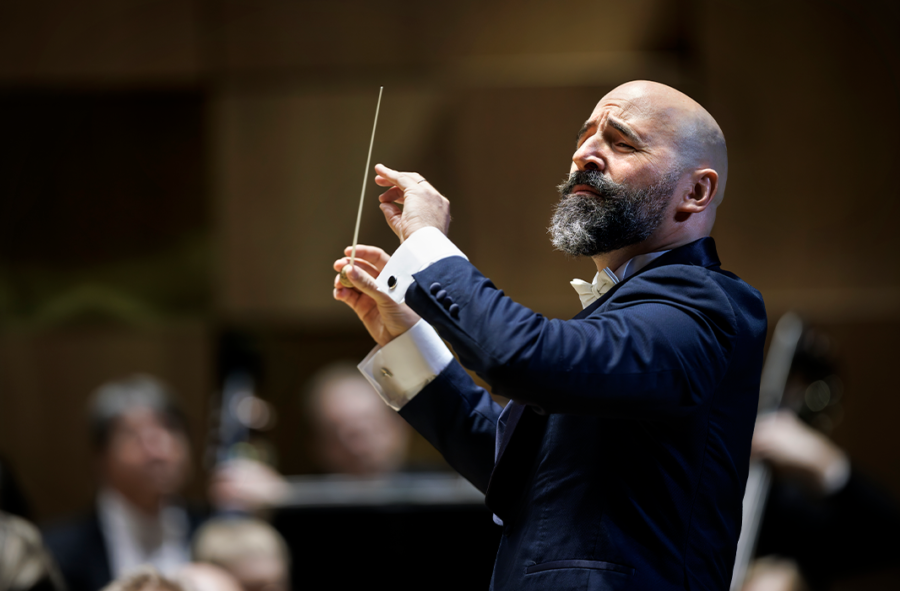
In the curtain speech, the conductor Martyn Brabbins cautioned the audience against experiencing Nilsson’s Fifth Symphony merely as a counterpoint to Beethoven’s Fifth. Heeding his words, I set aside my preconceptions and immersed myself in the sound. Nilsson’s Symphony opened with a lonely ringing of the bells, with the orchestra sections slowly creeping in to meet together in a celestial tutti. The atonality, the desperate, absurd concentration of the culmination points created a strangely supernatural but enthralling sound. The symphony carried echoes of Sibelius’s raw melodiousness and Mahler’s visionariness.
Nilsson plays with abrupt dynamic, agogic and chromatic contrasts to create tension. He builds themes on progressive melodies that develop the sense of urgency. He deconstructs the soundscape to the point that it becomes almost impossible to identify the soloist. Rejecting any displays of bravura, he sews the orchestra together into one living, breathing organism. The intermittent character of the melodic movements resembles the flows of inhalation and exhalation. The sections in Nilsson’s orchestra wake up and fall asleep under his command, creating stark contrasts between the electrifying tuttis and the dull, almost hypnotizing dronings of singular instruments. The atonal, repetitive, dense melodies are drowning in Nilsson’s sonic chaos and seem to take the form of themes only by accident.
I expected to crave classical order after the modern symphonic chaos of Nilsson’s symphony. Yet I found myself receiving Beethoven’s predictability as more underwhelming than soothing. The famous first four notes of Beethoven’s Fifth Symphony were played very carefully, as if afraid of their own magnitude. The sounds were reserved and subdued, as though played by a student reluctant to upstage the master as a mark of respect.
Despite the incontrovertible technical competence of the Malmö Symphony Orchestra, I couldn’t shake the feeling that this rendition of Beethoven’s symphony missed something vital. The performance felt too orderly and conventional. As if still bound by the guidelines from the first concert, the orchestra seemed to wait for the culmination points to show emotions, leaving the spaces in between them feeling hollow. Without the experimental, modern climactic intensity of the first concert, this emotional frugality felt idle.
While I could still appreciate the undeniable craftsmanship of Beethoven’s Fifth Symphony, the performance itself felt too safe. I was left feeling more appreciative than mesmerized. Though I expected the opposite, it was Nilsson’s Fifth Symphony that cast a long shadow over me and became the centerpiece of the concert.