
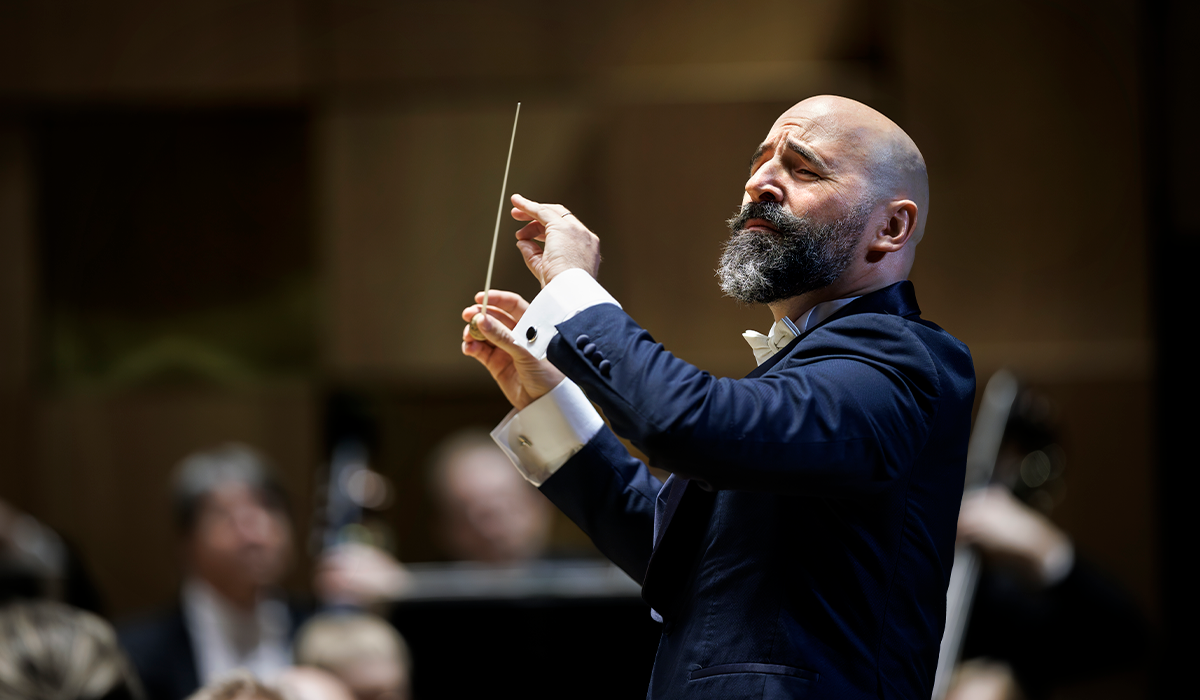
Claude Debussy’s words ”There is no theory. You have only to listen. Pleasure is the law” perfectly capture the experience of the four-part concert performed by Malmö Symphony Orchestra. The brilliant composition of the concert paired with the intuitive and versatile conducting of Pierre Bleuse constructed a truly immersive experience.
The concert began with the neat and elegant Fanfare from La Péri by Paul Dukas. Dukas was famously one of the least prolific composers in music history. A relentless reviser of his own work, he published only about 15 pieces, each marked by exceptional diligence and exactitude.
The second piece, Anticipations by Philippe Manouri introduced a sudden swerve from Dukas’ order to chaos. Manouri breaks with form and sonic fluidity, turning toward deconstructed music. I found myself reflecting on the fine line between music and noise. The dull, persistent sounds of the instruments made me see them as living organisms, running wild in rebellion against any restriction of sound.
The most surprising element was Manouri’s experiments with the acoustics of a concert hall. The brass section moved around the upper balcony, creating an interplay between sound and space. At some point I stopped questioning the construction of the piece and simply subjected myself to the holistic experience. Fittingly named, Anticipations closed on a caesura, an abrupt pause in the music, that left me unsure whether anything more would follow.
Pianist Jean-Efflam Bavouzet performed nothing short of virtuosity in the third installment of the performance, the Piano Concerto No 3 in E major by Béla Bartók. Surprisingly airy and effervescent, Bartók’s swan work stands in a stark contrast to his previous experimental compositions. The concerto integrates the structural clarity of Bach with Stravinsky’s vitality. Compared to the preceding Anticipations, the warm, tonal sounds of Bartók’s concerto made it appear much more accessible.
Claude Debussy defined music as ”the expression of the movement of the waters, the play of curves described by changing breezes”. He channeled his fascination with water into La Mer, three symphonic sketches that closed the musical tetralogy. Debussy treats water with reverence, succumbing to the element, and allowing its nature to guide the composition. La Mer encaptures the duality of the element. He adapts the pointillism technique of impressionist painters by overlapping the instrumental entries to weave a shimmering texture of sound.
Debussy’s brilliant instrumentation technique conveys billow waves. Repetitive, somnolent resonances create a sound mass that moves through the orchestra like the inflows and outflows of the sea. Debussy’s talent for beautiful melodies became undeniable with the strikingly beautiful theme at the end of the first sketch.
All four parts of the concert play with the form. First, the concise perfection of La Péri, second, the deconstructed composition of Anticipations, third, the light and regularity of Bartók’s Piano Concerto, and lastly, the illustrative freedom of La Mer.